
The perimeter is dead. For decades, security relied on a simple formula: a strong castle wall and trusted insiders. That model worked when employees were in offices, data lived in centres, and the network edge was clear. Today, the Zero Trust Revolution has made that fortress mentality a liability.
Welcome to The Zero Trust Revolution—the paradigm shift reshaping how organizations protect their most critical assets.
What is Zero Trust?
Zero Trust isn’t a single technology. This idea is at the heart of The Zero Trust Revolution. It is a comprehensive security philosophy built on one principle: never trust, always verify. Every access request—from employee, device, or service—is treated as hostile and must be authenticated, authorized, and encrypted before granting access.
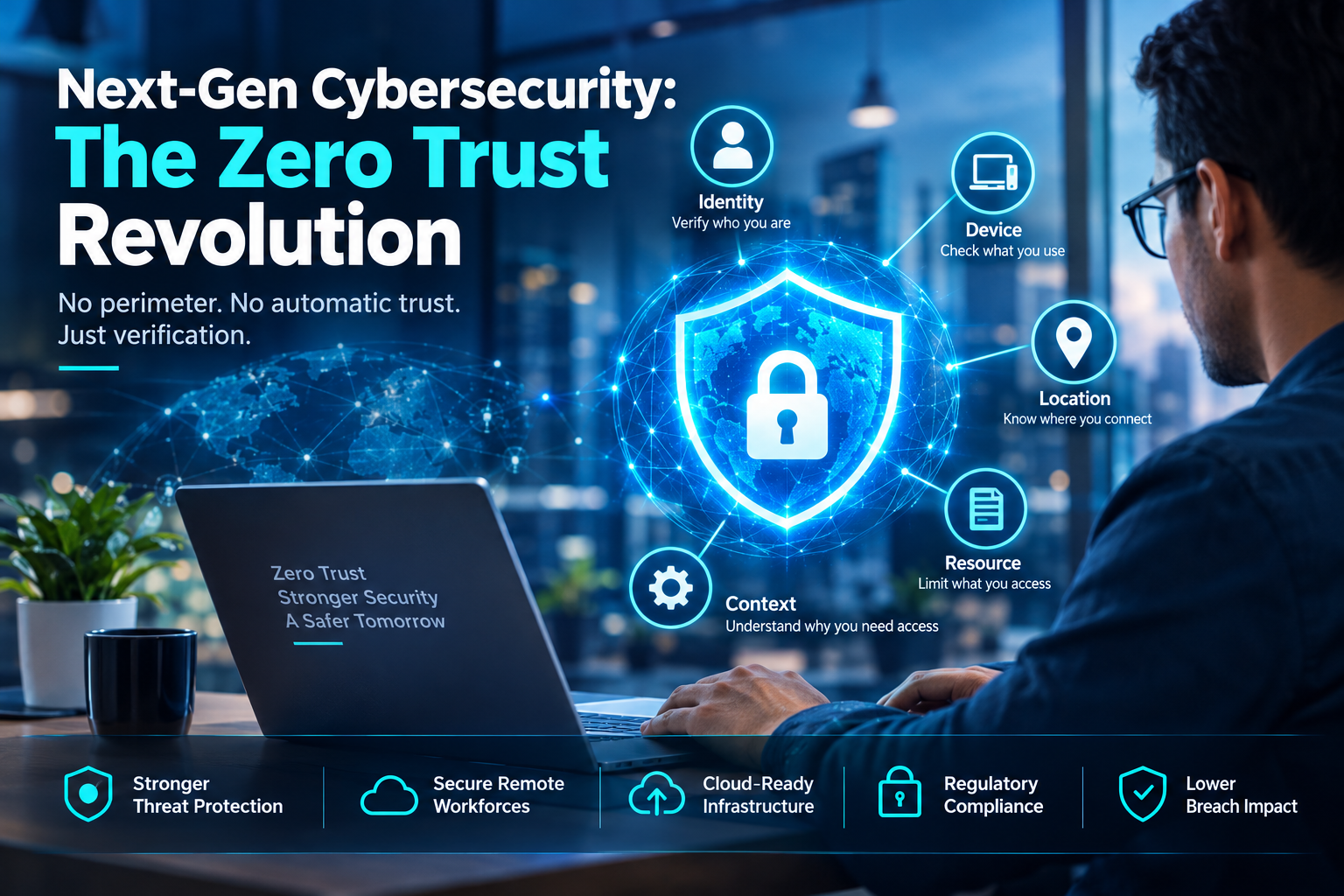
Instead of assuming insider access is safe, Zero Trust requires continuous verification of:
- Who you are (identity)
- What device are you using (device security)
- Where you’re connecting from (location)
- What you’re trying to access (resource)
- Why you need access (context)
Why Zero Trust Matters Now
The security landscape has fundamentally changed:
Remote and Hybrid Work: The office-based workforce is history. The Zero Trust Revolution drives new authentication and access controls as employees connect from coffee shops, airports, home offices, and everywhere in between. Traditional VPNs and perimeter defenses can’t keep pace.
Cloud-First Infrastructure: Data and applications no longer live behind a corporate firewall. They’re distributed across multiple cloud providers, making a “trusted inside” boundary impossible to maintain.
Insider Threats: Statista reports that insider incidents account for significant security breaches. Zero Trust assumes threats can originate anywhere—even from verified users.
Sophisticated Attackers: Breach techniques evolve daily. A single compromised credential can unlock lateral movement across an entire network. Zero Trust limits blast radius by micro-segmenting access.
Compliance Demands: Regulations like GDPR, HIPAA, and SOC 2 increasingly require granular access controls and audit trails—exactly what Zero Trust delivers.
The Core Pillars of Zero Trust
1. Identity Verification
Every user and service must prove who they are. This means:
- Multi-factor authentication (MFA) for all users
- Passwordless authentication where possible
- Identity and access management (IAM) platforms that enforce strong policies
- Continuous verification—not just at login, but throughout the session
2. Device Security
No device is inherently trusted. Enforce:
- Endpoint detection and response (EDR) to identify threats
- Mobile device management (MDM) for inventory and security compliance
- Patch management to eliminate known vulnerabilities
- Encryption of data both in transit and at rest
3. Microsegmentation
Divide the network into tiny, isolated zones:
- Each application or resource gets its own security boundary
- Users can only access what they need—not entire network segments
- Reduces lateral movement if a device is compromised
- Makes breach containment automatic
4. Least Privilege Access (LPA)
Grant only the minimum permissions necessary:
- Just-in-time (JIT) access that expires automatically
- Just-enough-administration (JEA) for administrative tasks
- Regular access reviews to remove unnecessary permissions
- Automatic provisioning and deprovisioning as roles change
5. Continuous Monitoring
Trust is verified through constant observation:
- Real-time security analytics and logging
- Behavioral analysis to detect anomalies
- Automated threat detection and response
- Full audit trails for compliance
From Theory to Practice: Implementation
Zero Trust isn’t an overnight transformation. Organizations typically adopt it in phases:
Phase 1: Foundation
- Deploy identity and access management (Okta, Azure AD, etc.)
- Implement MFA across all accounts
- Begin monitoring and logging
- Audit current permissions and access
Phase 2: Applications & Connectivity
- Microsegment critical applications
- Deploy secure access service edge (SASE) solutions
- Implement zero-trust network access (using tools like BeyondTrust or Zscaler)
- Enforce device compliance
Phase 3: Scale & Optimization
- Automate access decisions with ML-driven analytics
- Extend to cloud infrastructure and APIs
- Integrate with security operations center (SOC) workflows
- Refine policies based on usage data
Real-World Benefits
Reduced Breach Impact: When Okta experienced a breach attempt in 2023, their Zero Trust architecture contained the blast radius. Attackers couldn’t freely move across systems.
Faster Remote Onboarding: New hires can work securely within hours, not days, with automatic provisioning against Zero Trust policies.
Regulatory Confidence: Auditors favor Zero Trust because granular controls and continuous logging demonstrate compliance.
Insider Threat Detection: Unusual access patterns trigger alerts before damage occurs—like detecting an employee accessing HR databases when they work in engineering.
The Reality Check: Implementation Challenges
Implementing Zero Trust is non-trivial:
Complexity: Every service, API, and application needs to participate. Legacy systems often don’t support modern authentication protocols.
User Experience: Aggressive security can slow workflows. The best Zero Trust implementations balance security with usability.
Cultural Shift: Teams accustomed to network-perimeter thinking need education and buy-in.
Cost: Tools, consulting, and integration add up. Budget $500K-$5M+ depending on organizational size.
The Verdict: Zero Trust Isn’t Optional
The question isn’t whether to adopt Zero Trust—it’s when and how fast. Every major security authority, from NIST to the NSA to Gartner, now recommends Zero Trust as the foundation of modern security.
The traditional perimeter is gone. What remains are identities, devices, and data. Zero Trust protects all three by verifying, limiting, and monitoring every access request.
In a world where attackers are sophisticated, insiders can be threats, and your users work everywhere, assuming trust is no longer a strategy—it’s a liability.
The future of security isn’t about building bigger walls. It’s about trusting nothing by default and verifying everything.