
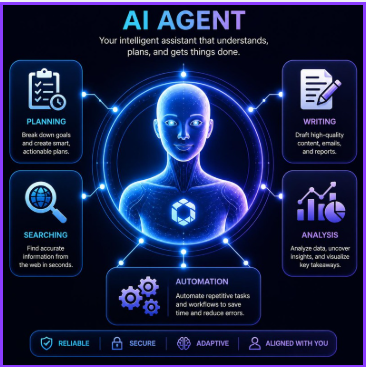
In recent years, you may have heard the term AI Agent thrown around in tech discussions and sci-fi conversations.
But what exactly is an AI Agent, and why should you care?
Additionally, Get to know AI Agents.
Let’s break it down in a way that makes sense.
What Is an AI Agent?
An AI Agent is a software system that can perceive its environment, make decisions, and take actions to achieve specific goals—often with minimal human intervention. Think of it as a digital assistant that doesn’t just respond to questions but actively works toward objectives on your behalf.
Unlike traditional chatbots that simply answer questions you ask them, AI Agents are proactive. They can observe situations, reason about what needs to happen, and then take independent action. They’re autonomous, goal-oriented, and capable of learning from their experiences.
Key Characteristics of AI Agents
Not every piece of AI software is an agent. True AI Agents share several defining characteristics:
1. Autonomy Agents operate independently without constant human guidance. They make decisions and execute actions based on their programming and learned behaviors.
2. Perception Agents can sense or access information from their environment—whether that’s data from a database, information from the internet, or sensor inputs from physical devices.
3. Goal-Orientation Each agent is designed to accomplish specific objectives. Whether it’s scheduling meetings, monitoring systems, or managing inventory, the agent has a clear purpose.
4. Adaptability Agents can adjust their behavior based on changing circumstances and feedback from their environment.
5. Interaction Many agents can communicate with other agents, systems, and humans to gather information or coordinate actions.
How Do AI Agents Work?
The basic workflow of an AI Agent follows a cycle called the “sense-think-act” loop:
Step 1: Sense (Perception). The agent observes its environment, gathering inputs from multiple sources to form situational awareness. This includes reading data from your inbox, checking the current time, and examining available databases to understand what is happening around it.
Moreover, the agent may monitor real-time information to stay updated. It uses these observations as the basis for initial judgments and actions, guiding what it does next as it perceives changes in the environment.
Step 2: Think (Decision-Making) Using its underlying AI model (often a large language model), the agent processes the information it has gathered. It reasons about what needs to be done, considering its goals, available actions, and the current situation.
Step 3: Act (Execution) Based on its reasoning, the agent takes action. This could be sending an email, creating a calendar entry, updating a spreadsheet, calling an API, or triggering a workflow.
Step 4: Learn (Feedback) The agent observes the results of its actions and incorporates this feedback to improve future decisions.
This cycle repeats continuously, allowing agents to operate autonomously over time.
Real-World Examples
1. Customer Service Agents An AI Agent in a customer support system reads incoming tickets, categorizes them by urgency, drafts responses, and routes complex issues to human agents—all while learning from how issues are resolved.
2. Personal Assistant Agents Imagine an agent that manages your calendar. It receives meeting requests, checks your availability, proposes times to multiple people, sends confirmations, and reschedules conflicts automatically.
3. Business Process Agents An agent might monitor invoices, flag overdue payments, draft reminder emails, and update accounting records—streamlining tedious administrative work.
4. Research Agents These agents can search the web, synthesize information from multiple sources, and compile reports without human intervention.
5. Code-Writing Agents Developers can delegate coding tasks to agents that understand project requirements, write code, test it, and fix issues.
The Technology Behind AI Agents
Most modern AI Agents are powered by large language models (LLMs) like Claude, combined with special capabilities:
Tool Access Agents gain power through access to tools or APIs. These might include:
- Email systems
- Calendar applications
- Databases
- APIs for web services
- File storage systems
- Specialized software
Reasoning Abilities The AI model can break down complex tasks into steps, reason about the best approach, and correct course if something goes wrong.
Memory Many agents maintain context from previous interactions, allowing them to understand ongoing situations and maintain consistency over time.
Planning Advanced agents can create multi-step plans to achieve complex goals, similar to how a human would approach a project.
Benefits of AI Agents
Time Savings Agents handle repetitive, time-consuming tasks, freeing humans to focus on higher-value work.
Consistency Agents execute tasks the same way every time, reducing human error.
24/7 Operation Unlike humans, agents can work around the clock without fatigue.
Scalability One agent can handle the workload of multiple humans, making it easier to scale operations.
Improved Decision-Making By processing more data faster than humans can, agents can support better decision-making.
Current Limitations and Challenges
Despite their promise, AI Agents still face important challenges:
Accuracy and Reliability Agents can still make mistakes or misunderstand instructions, particularly in ambiguous situations.
Safety and Oversight Ensuring agents stay aligned with human values and intentions requires careful design and monitoring.
Transparency Understanding why an agent made a particular decision can be difficult, which matters for high-stakes applications.
Integration Complexity Connecting agents to existing systems and tools can be technically complex.
Scope Limitations Today’s agents excel at specific, well-defined tasks but struggle with highly novel or creative challenges.
The Future of AI Agents
The field is evolving rapidly. We can expect:
- More Sophisticated Planning: Agents that can handle increasingly complex, multi-stage objectives
- Better Specialization: Agents fine-tuned for specific industries or use cases
- Improved Human-Agent Collaboration: Tools that make it easier for humans and agents to work together seamlessly
- Enhanced Safety Measures: Better ways to ensure agents operate safely and predictably
- Greater Autonomy: Agents that require less human oversight while remaining trustworthy
Conclusion
Get to know AI Agents.
They represent a significant evolution in how we interact with technology.
However, they move beyond simple command responses.
They proactively work toward goals and handle complex tasks with minimal supervision.
Whether you’re a business looking to streamline operations, a developer building applications, or simply curious about AI’s future, understanding AI Agents is increasingly important. They’re not science fiction—they’re practical tools being deployed today to solve real problems.
As this technology continues to mature, we’ll likely see AI Agents become as fundamental to how we work as email and spreadsheets are today. The key is ensuring they’re designed and deployed responsibly, with appropriate human oversight and clear value.