
Generative AI is transforming the way content is created, published, and consumed worldwide. Whether it’s blog posts, social media updates, videos, images, music, or software, artificial intelligence is emerging as a powerful creative tool for individuals, businesses, educators, and media outlets.
However, generative AI is more than just a tool for speeding up content production. It is reshaping the creative process itself and prompting critical discussions about originality, quality, copyright, human creativity, and what lies ahead for creative professions.
generative ai
What Is Generative AI?
Generative artificial intelligence refers to AI systems that can create new content based on instructions, examples, or other forms of input.
Unlike traditional software that follows predefined rules, generative AI can produce original-looking outputs such as:
- Blog articles and reports
- Images and illustrations
- Videos and animations
- Music and audio
- Presentations
- Computer code
- Marketing materials
- Social media content
A user can provide a simple prompt describing what they want, and an AI system can generate a starting point within seconds.
This makes generative AI particularly valuable for content creators who need to research ideas, develop drafts, experiment with formats, or produce content at scale.
How Generative AI Is Transforming Content Creation
1. Faster Content Production
One of generative AI’s biggest advantages is speed.
Creating a high-quality article, marketing campaign, video script, or social media strategy can traditionally require hours of research and writing. AI tools can help creators generate outlines, brainstorm ideas, create first drafts, and reorganize existing material much faster.
However, speed should not replace quality. Human review remains important for accuracy, originality, tone, and context.
2. New Opportunities for Bloggers
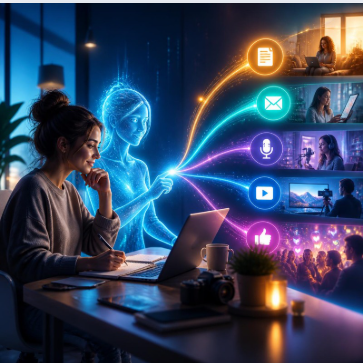
New opportunities for bloggers
Generative AI is particularly useful for bloggers and independent publishers.
A creator can use AI to brainstorm article topics, develop headlines, create outlines, identify reader questions, and improve a draft’s structure.
For example, instead of starting with a blank page, a blogger could ask an AI assistant to develop five possible approaches to an article about cybersecurity. The writer can then choose an approach, conduct research, add original insights, and turn the outline into a complete article.
The result is a workflow where AI assists the writer rather than replacing them.
3. AI-Generated Images and Video
Generative AI is also transforming visual content.
Creators can describe an image or video concept in natural language and use AI-powered tools to generate visual material. This can help small businesses, bloggers, educators, and social media creators produce visuals without requiring advanced design or video-production skills.
This development could make professional-looking visual communication more accessible to people with limited resources.
4. Personalized Content

Another major development is personalization.
AI can help organizations create different versions of content for different audiences. A business might adapt the same basic message for customers, employees, students, or social media followers.
Educational platforms can also use AI to provide explanations that match different learning levels and communication styles.
This means content creation may increasingly move from a one-size-fits-all model toward more personalized experiences.
Human Creativity Still Matters
The rise of generative AI does not eliminate the importance of human creativity.
AI can generate thousands of ideas, but humans still provide goals, judgment, experience, cultural understanding, and personal perspective.
A successful content creator needs to know:
What should be created?
Who is it for?
Why does it matter?
Is the information accurate?
Does it provide something genuinely useful?
These questions cannot be solved simply by generating more text or images.
The strongest creative workflows are therefore likely to combine artificial intelligence with human judgment.
The Importance of AI-Assisted Storytelling
Generative AI can help creators explore different storytelling possibilities.
A writer might use AI to experiment with headlines, introductions, story structures, dialogue, or different explanations of a complicated topic. A video creator can use it to develop scripts and storyboards. A marketer can test multiple versions of a campaign concept.
The creator remains responsible for selecting, editing, verifying, and improving the final result.
In this model, AI becomes a creative collaborator rather than an automatic replacement for the creator.
Challenges and Risks
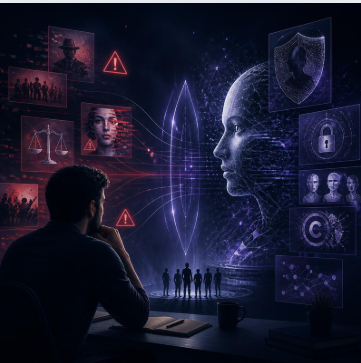
Despite its potential, generative AI introduces significant challenges.
Accuracy and Misinformation
AI systems can sometimes produce incorrect information or present uncertain claims with confidence. For this reason, creators should verify important facts before publishing AI-assisted content.
Human fact-checking is especially important for news, education, finance, science, technology, and other areas where inaccurate information can cause harm.
Copyright and Ownership
Generative AI also raises complex questions about copyright and ownership.
Creators, publishers, technology companies, and policymakers continue to debate issues surrounding training data, intellectual property, AI-generated works, and the rights of original creators.
Content professionals should therefore pay attention to the terms and policies of the AI tools they use.
Loss of Originality
Another concern is that excessive reliance on AI could lead to repetitive content.
If thousands of websites use similar prompts and AI-generated structures, the internet could become filled with content that looks polished but lacks unique perspectives.
Original research, personal experience, expert knowledge, and strong editorial judgment can help creators stand out.
Generative AI and SEO

Generative AI is also influencing search engine optimization.
AI can help content creators brainstorm keywords, organize topics, generate article outlines, and improve readability. However, simply producing large amounts of AI-generated content does not guarantee search visibility or audience engagement.
Successful websites still need useful information, strong organization, trustworthy sources, good user experiences, and content that genuinely addresses readers’ needs.
The future of SEO may therefore focus even more strongly on quality, usefulness, originality, and credibility.
The Future of Creative Jobs
Generative AI is likely to change many creative professions.
Writers, designers, marketers, video producers, programmers, and other professionals may increasingly use AI as part of their everyday workflows.
Some tasks that once required significant amounts of manual work may become automated. At the same time, new roles and skills may emerge around AI-assisted production, editing, fact-checking, prompt design, content strategy, AI governance, and creative direction.
Rather than thinking only about whether AI will replace creative professionals, it may be more useful to consider how creative professionals will adapt to working alongside AI.
The New Content Creation Workflow
A future content workflow could look like this:
Idea → Research → AI Assistance → Human Creation → Fact-Checking → Editing → Publishing → Audience Feedback
In this model, AI supports several stages of the process while humans remain responsible for the creative vision and final decisions.
This approach can combine the speed of machines with the judgment and creativity of people.
What Content Creators Should Do Today
Creators who want to prepare for the future can begin by developing practical AI skills.
Learn how to write effective prompts
Clear instructions generally produce more useful results. Learn how to describe the audience, purpose, tone, format, and desired outcome.
Use AI for brainstorming
Instead of asking AI to create everything, use it to explore ideas and identify different approaches.
Verify information
Never assume that AI-generated information is automatically correct. Check important facts against reliable sources.
Add your own perspective
Personal experience, original research, interviews, examples, opinions, and expertise can make content more valuable and distinctive.
Develop strong editing skills
AI can produce a draft, but editing determines whether that draft becomes useful, accurate, and engaging content.
Conclusion
Generative AI is transforming content creation from the first idea to the final publication.
It can make creative work faster, help people experiment with new formats, and give individuals and small organizations access to powerful production capabilities. At the same time, it introduces challenges involving accuracy, copyright, originality, and responsible use.
The future of content creation is unlikely to be simply AI versus humans.
Instead, it will increasingly be about humans working with AI.
Creators who learn how to combine artificial intelligence with research, creativity, critical thinking, and authentic human perspective will be better positioned to produce meaningful content in an increasingly AI-powered digital world.